Showing posts with label Article Review. Show all posts

Wednesday, October 17, 2012

Dark Definition

Photo by Whitney Erin Boesel
Alexis Madrigal has a very interesting article over at The Atlantic on a topic he calls dark social, or web traffic driven by non-referred sources outside of those generated on traditional social platforms.  Even though the dominant narrative places the innovative crown of web-connection on sites like Wikipedia, MySpace, Facebook, and so on, the article provides undeniable proof that so-called 'dark social' forces- links shared over gchat, email or personal connection- actually drive the majority of web traffic.

Madrigal interlaces his data-backed revelations with anecdotal tales on his use of 90's era communicative platforms like ICQ and USENET to share links with his friends, the contrasting effect meant to convey a sense of experiential validation on the larger thesis of the piece.  If almost 70% of traffic occurs through means outside of those facilitated by, say, 'liking' and 'sharing' something on Facebook or retweeting an interesting link shared on Twitter, then what does that say about the narratives telling us how we use the web?  On a larger level, what does inclusion of this 'dark social' data say about our levels of perception and the limits circumscribed therein?  
Photo by Sparkieg
I think it says that we are just beginning to understand how our constant activity of being social in existence- not just on a platform- shapes and drives our measurable presence on the web.  I also think Madrigal is correct in his stylistic choice and logical juxtaposition of narratives driven by data and experience because it is easy to conflate the two in our digital world, even though the first is limited by our perception of what counts as web traffic and the second is a more authentic description of the lived reality behind the web traffic.  One has to describe their anecdotal experience of link sharing precisely because this 'through a social, darkly' behavior is not actively measured by our current generation of analytic tools.

What this suggests to me is that we need to engage in far more ethnography of the link.  The bits of data, the shared cultural units, are not ends unto themselves.  The rituals behind those acts of sharing- the reading of email, the dialogue of gchat- all require a larger presence in our analyses if we are to understand this 'dark' behavior.  But that's not all. 

Photo by Kit
What occurred to me while reading this piece is how the core issue exposed, that our sweeping range of quantifiable social perception is limited to such a degree so as to render entire behaviors 'dark', has much in common with the ongoing debate surrounding the role and purpose of the Digital Humanities.  There is a lot of talk about what the digital humanities are and what defines their use, but I think these are misleading questions that are both unproductive and illusionary in their symphonic promise of clarity.  Much like Madrigal's discovery of 'dark social', the key thing we need to keep in mind when discussing the digital humanities is that our understanding of what the field means and sources for its definition are chiefly limited by perceptional capacity or measured results.  Knowing this, we should take a cue from Madrigal's piece above and instead devote a portion of our analytic inquiry towards pursuing ethnography of the digital humanities act itself.

I want to take a moment and explain what I mean by briefly examining the relationship between game studies and the digital humanities.

Stephen Ramsay famously stated that building and making were the hallmarks of digital humanities work, and while he included a place of respect for the field of game studies in the pursuit of humanistic inquiry, he regarded it more as an inquiry on reading and less than an inquiry on making.  Some might find this a convincing narrative.  Regardless of that fact, it is nonetheless an incorrect narrative that ignores a fundamental quality of game studies- studying the act of play.

Earlier, on Twitter, I was included on a discussion about the idea of perma-death (permanent death) in game design and how the mud-dev forums contained an epic thread on the issue.
Nick LaLone replied that he wanted to put together research "that re-publishes a lot of the 'lost' early/mid 90's game studies', the implication being that our current critiques are lacking in recognition of earlier efforts, the 'dark' 90's being the example displayed here.  Our vision, our perception of the game studies field, is necessarily lacking until we at least uncover these lost sources.  But there is something deeper here- the idea that these sources might speak to the act of play and in doing so become far more valuable in this role than they could as just simple, dated observations.  Game studies inherently understands the need for good ethnography, because good ethnography is at the heart of understanding play.

In my own research with board games, I've found user created forums to be invaluable portals into the motivations behind creation of game modifications or debates on the alignment of design mechanics and theme.  What gives these sometimes-odd assortments of messages and debates credibility are their linkages to the active process of play.  Players create from their ludic experiences narratives that, in turn, inspire the creation or analysis on game-effects generated through play.  This is far more active process than that required of simply reading the rules and inferring the intent of design mechanics, or 'surveying the data' if you will.  It is also a process filled with potential ethnographic insights into cultural perspective and the larger workings behind integrating symbols and meanings into a coherent experience.

By performing ethnographic analysis of the play act itself, this 'dark' ludic experience can increasingly become revealed.  Analyzing player written After Action Reports (AAR's), or reviews of game sessions, can yield fascinating insight into how play connects embedded cultural narratives to historical interpretations.  Player created modifications, such as translating game materials into another language or introducing new materials or rules, and their dependency on digital networks of today is yet another avenue where one can analyze the bulding/sharing/deforming process tied to games as cultural artifacts.  Where Ramsay saw reading, I see more.  But, again, we return to questions centered on levels of perception and the limits circumscribed within.

Now Ramsay equated game studies as directed more towards humanistic reading and less towards humanistic building at his 'own peril'.  I suspect he included the caveat because he understood that by endorsing building over reading there was an implicit acknowledgment that something new always lay over the horizon.  Mark Sample goes so far as to say that digital humanities isn't about making or building at all; it's about sharing- maybe even breaking or deforming- what we study.  "When something breaks, it makes a beautiful sound," read the lyrics of 'Blue Arrangements' by the Silver Jews, and I can't help but think Sample would agree.

This optimistic note sounded by Ramsay and Sample in the pursuit of a productive digital humanities definition finds resonance in the tone of Madrigal's piece, especially when he includes personal details associated with his nerdish delight upon discovering the degree of influence 'dark social' wields.  It's the same feeling I get when studying how the active process of play shapes someone's conception and reflection of the past.  It is never a question of how good your data is, although good data is essential to good analysis.  It is always a question of how good your questions are, and whether those questions will probe and ply your data to not only reveal new insights, but perhaps also demonstrate the limit of what insights your data can provide

Underlying each of these positions is the discovery that our process- in creating social acts or building/breaking/sharing digital humanities projects- is more important and more informative when we take into account the experience and not just the data.  Defining and measuring data might sound active, but it's really static.  Doing is active.  Sharing is active.  Building and breaking are active.  And to understand both the digital humanities and social behavior better, we need a wider perspective that includes an ethnographic approach at its core.

Monday, March 5, 2012

Going Beyond the Textual in History

Photo by Andrew Mason
Because of my interest in both history and games, I'm always on the look-out for good writing or new takes on how to bring elements of the gaming world into the framework of historical inquiry.  Increasingly, I'm finding my best sources of this kind of reading from my Twitter stream, as was the case when Shawn Graham (@electricarchaeo) pointed me towards an article in the recent edition of the Canadian Game Studies Association journal, 'Loading…', titled 'Beyond the 'Historical' Simulation: Using Theories of History to Inform Scholarly Game Design'.  Tackling what they call 'gamic action', the authors of the paper look to use elements of 'procedural rhetoric' (a concept introduced by Ian Bogost in his work 'Persuasive Games') combined with 'valid and scholarly means' of constructing the past (modeled on the monograph or print article) to produce 'reasonably justified truths' compatible with current methodologies in use by many historians.    

I mention the article not because I found it to be a progressive example of innovative historical thinking on games, but rather the opposite.  Instead of offering a means by which games can be productively and thoughtfully incorporated into historical study, the authors present a reactionary stance that seeks to bind 'gamic action' within the tightly defined epistemological boundaries incorporated into textual modes of history.  While they do offer valid insight when it comes to analyzing the roles and pretenses games follow today with regards to claiming historical validation, the repeated insistence on bringing into alignment the modes of 'objective' history and playable games not only overlooks the complimentary nature of both in creating reasonably justified truths about the past (to borrow a central concern of the authors), but also ignores the more fundamental issue centered on student prosumption (production + consumption) of historical knowledge.

Photo by Caro's Lines
While the first objection stems from concern the authors profess regarding games ability to present historical 'truth' as exemplified by the monograph, the second objection goes to the core of a fundamental debate now occurring in the discipline of History.  Examining both these objections yields the insight that History must go beyond the textual when forming links outside the circumscribed boundaries current epistemologies demand.  This is not abandonment, it is augmentation.  Rather than take a simplistic, reductionist view of the interplay between history and games, it might suit both the Historian and the Student better to uncover the more nuanced and complex interoperability both spheres of knowledge possess.

Let's begin with what the authors define as the 'gamic mode'.
"A gamic mode of history is the construction of scholarly historical arguments as scholarly games, creating a relationship to commercial games analogous to that of non-fiction to fiction in literature. This enables scholars to convey their research in ways that go beyond the limits of textual monographs, digitized historical sources, and digital simulations." [3]
via schaver.com
Thus the introduction of two parallel themes that run through the entire article- first, that scholarly historic arguments can be laid 1:1 over the gamic mode and, second, that this gives the gamic mode a source of truth to which other, commercial games cannot lay claim.  Simply put, the two worlds of textual history and games cannot coexist unless they are mirrors of each other, for to allow the possibility of transition between distinct spheres of knowledge would imply that truth is relative and the certified authority of the historian is no greater than the roll of a die or play of a card.  Students/players, in the 'commercial' and 'simulative' gamic modes, are empowered to both consume and produce knowledge on a level that is difficult for traditional Historians to acknowledge, much less accept.

This fear is clearly expressed by the authors when they claim that current methods of integrating games and history steer the debate away from expressing and elaborating "a disciplinary way of creating truth" and ultimately seek to transform the discipline by altering its epistemologies and limiting its empirical rigor.  Hence the following claim by the authors:
"This [steering of the debate] in turn limits scholarly debate by increasing ambiguity and opening reader response beyond the determination of whether or not the author has presented a reasonably justified truth." [5-6]
While that statement certainly seems ominous, the real source of angst is not the debate on epistemology, truth and empirical rigor conflating history and games supposedly brings about- it's the fact that the reader is apportioned a space of interpretation hereto held inviolate by certified authorities of the historical profession.  The gamic mode, as the authors see it currently being applied, allows the reader (note careful avoidance of the term 'player') to produce responses that go beyond consumption and simple affirmation or negation of the argument presented.  The reader, enabled to produce (or, more accurately, prosume) their own 'truths', can simply avoid the argument altogether.

Instead of dwelling on this point, let's put it in our back pocket as we survey other important parts of the authors argument.

One key concept that helps the authors align fidelity of the historical textual mode to the gamic mode is procedural rhetoric, a term first introduced and elaborated by Ian Bogost, defined in this context as:
"…the use of computational processes to persuasively and effectively convey an idea. What the author creates in procedural rhetoric is not the argument itself, but a series of general and specific rules through authoring code that a computer can then use to generate the argument (Bogost, 2007). This mirrors scholarly constructions of the past as history in two important ways. First is that the argument is not the past, but a representation of it created by authoring evidential and interpretive relationships that lead to conclusions. Second is that the scholarly historical argument itself consists of facts that are converted to evidence and arranged according to a set of rules for that particular argument via interpretation. The gamic mode of history is an application of procedural rhetoric that takes advantage of the processes inherent in scholarly evidential relationships to express these arguments as games.  While different in form the argument experienced by the player would contain the same series of procedural evidential relationships that work towards a verifiable conclusion with a reasonably justifiable truth attribute that they might have expected to find in a monograph of the same argument." [6]
By linking 'computational processes' to the way in which textual arguments are assembled, the authors hope to bring authoritative strength to their claim that the gamic mode and the textual historical argument can be one and the same.  However, this viewpoint hinges on the assumption that digital games possess an internal consistency of rules and play that allow the player to understand and predict cause/effect relationships in the gamic world.  This, unfortunately, is not the case.

Photo by Ken Goldberg
Digital games are, by their very nature, closed constructions whose operation the player cannot, on face, intrinsically know or predict without engaging first in a large degree of play.  Cause/effect relationships in digital games are determined by trial and error, inference, and the acknowledgment of a reward to indicate progress.  Yet the player can never be sure every corner of a digital game has been explored because many actions are obscured by the operation of code, which the player often cannot access and modify.  In fact, a digital game could be considered the exact opposite of a monograph, where the argument and sources used are clearly articulated.  But of course, this too simplifies the monographs presence, which is never really accounted for in the article.  For while citations are visible the documents behind those citations are not.  Alternatively, we know what the scholar selected but we don't know what they didn't select, or even the range of documents surveyed.  This is not a knock on professionalism, merely the idea that History in pursuit of objectivity nevertheless is guided, perhaps unknowingly, by subjective desires.

There is also the question of why the authors are so dedicated to digital gamic action, leaving the venerable tradition of manual board gaming to the relative wayside.  I find this trend currently common in many historic approaches towards utilizing games- but without straying too far from the question at hand, I would add that board games at least allow an alternative separate from the digital gamic mode to occur.  Board games are 'open' and the player does not have to continually press the boundaries of the world to figure out its meaning, a la digital.  Complete boundaries are defined and areas of ambiguity are not hidden but rather demarcated quite visibly in a manual design.  The player can dispense with the never-knowing and move straight to analysis and interpretation.  It should also be noted that the 'open' design of manual games allows players to assert their own interpretations of the events or model depicted, something the authors, as cited above, greatly disdain.

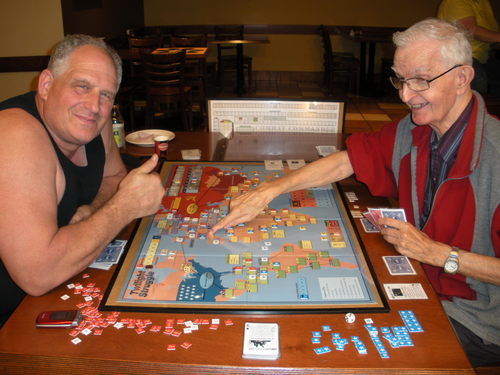
Player-Made Twilight Struggle Card
by Mark MacRae
To put it on even simpler terms- the main objection the authors have with current gamic modes is that they produce history for consumers, while the authors would much rather produce history for producers.  This approach, currently, is endemic in the historical discipline because historians, by and large, are used to being both the producers and consumers of their own product.  This is why the authors struggle so mightily to make equivalent a textual mode of history and a gamic mode of history, to make claims that this approach can, perhaps, go beyond the textual when, in fact, the very notion of equivalence negates this possibility.  Textual modes focus on producing knowledge through reading, while gamic modes focus on producing knowledge through play.  One allows simple consumption, the other complex prosumption.

Stalwart defense of the 'consumptive' textual mode can be further seen in the authors elaboration of Alan Munslow's three broad epistemological approaches to historical scholarship, those being construction, deconstruction and reconstruction.  Because deconstruction relies upon one's own experiences to form understanding of evidence and arguments presented, the authors reject such claims of historic inquiry because "to certain extent (deconstruction) means the past is unknowable and denies a corporate understanding of history."  Reconstruction is similarly disqualified as its primary exemplar, the computer simulation, asserts that collected facts of the past can be arranged and recreated to simulate the past as it actually happened- yet this involves subjective qualifiers and emphases that the authors stress "taxes the traditional historian's ideal of objective scholarship." 

This leaves construction as the preferred epistemological approach in producing an authoritative historical gamic mode.
"Constructionist history builds up knowledge of the past and expresses the past as history by both analyzing how and what individual pieces of evidence can do, and what conclusions about the actions of historical agents (be they individuals or corporate entities) can be established through evidence relationships. In this case, evidence itself is separate from a notion of historical fact, as the fact only becomes evidence based upon its relationship to the question at hand. The constructionist approach to history, while allowing almost any question to be asked, provides parameters around how the question can be answered." [7]
What gives construction the edge for the authors is that it neatly lays outs parameters establishing how 'almost any question…asked' can actually be answered.  Construction also goes hand-in-hand with the use of narrative to act as the communicator of historical truth.  Narrative as communicator of truth is so vitally important to the authors that they express fear in letting the student have input on interpretation outside of that directed by the Historian:
"Narrative is so closely tied to our understanding of action, and as history is the study of past action, that if the historian’s prose does not present a cohesive narrative to the reader, the reader then creates one. Therefore, the gamic mode of history needs to be able to utilize narrative in the same way." [8]
This is not 'meaningful' description.
 Photo by Phil Romans
Under this rationale, it becomes easy for the authors to question the role of any gamic mode in which the student/player becomes a nexus of interaction or interpretation of historical evidence.  Simulations and counter-factuals, the bread and butter of commercial games, are thus scorned by the authors because they allow the student/player to feel as though their actions create meaningful and accurate depictions of the past without utilizing "empirical, justified truths claims about the past."

The solution presented by the authors is Shadows of Utopia: Exploring the Thinking of Robert Owen, a digital game that lets players simulate "an argument about Robert Owen's thinking."  Placing questions of education and labor reform before the player expressed through puzzles and game-world exploration, Shadows of Utopia demonstrates the idealistic thinking of Robert Owen via player transformation of the game-world's 'lazy, foolish shadow-creatures who steal and rob' into real people who attain wealth and morals through factory work.  Mimicking the textual authenticator of citations, Shadows of Utopia provides in-game source documentation in a transparent manner, going so far as to link "sources and related interpretations to the game code, user interface, and aesthetic choices," although how this is accomplished is not specifically defined.

The authors conclude that efforts like Shadows of Utopia not only can "do all the things that the textual mode does" but also "add digital utilities that augment research in imaginative and useful ways." 

Now, to be clear and upfront, I think that Shadows of Utopia sounds like a fascinating attempt to bridge the epistemological gap between what we understand to be the practice of history with the act of play encountered in the gamic mode.  However, I'm not willing to burn all other existing and potential bridges from history to games as the authors of 'Beyond the Historical Simulation' have done.  For one thing, porting (to borrow a phrase from digital gaming) over the epistemological guidelines of textual monographs and journal articles to the gamic mode doesn't allow one to go beyond the textual mode- it merely extends that mode to gamic space without taking into account the unique epistemologies gamic space inherently possesses.  (The authors want to 'paper over' the gamic space, literally, with textual modes)  To make a simple point of comparison, a monograph does not seek reader input whereas a game, by its very nature, requires player input to be utilized.  When you read a journal article, you are passively absorbing knowledge.  When you play a game, you are actively absorbing knowledge.  The authors argument presented above seeks to appropriate player activity and channel it into passive knowledge absorption.

Instead of trying to simplify the conflation of history and games, perhaps it would be better to acknowledge their separate epistemological boundaries and formulate a way to negotiate knowledge handoffs between the two spheres.  Katie King in her recent work Networked Reenactments, points the way to just such a negotiation in her analysis of flexible knowledges and pastpresents displayed in commercially produced television reenactments.  Here we often see the interplay of several fields of knowledge, represented either by talking heads or physical actualization of knowledge epistemologies through representative involvement (i.e. having a Historian and Architect work together in recreating a Roman bath), set against the backdrop of a historical narrative that links the past to the present.  When you add in the viewer angle to reenactments, the demarcation of specialized knowledge becomes less and less viable as the flexible knowledges required to fulfill the reenactment demand greater mobility than tight epistemologies might otherwise demand.  Thus King notes,
"…it is especially important that reenactments are not a way to keep pasts and presents apart-or a way to keep authorities and alternative knowledges, metaphors and referents, materialities and abstractions, forms of academic expertise and cultural entertainment, or affects and cognitions separated, managed, or delimited by membership. Flexible knowledges, transdisciplinarities, new media, all plunge us into uncertainties, risk, collusion, and collaboration; all conditions that-as with responsibilities to multiple audiences from painfully limited authorships-we do not control and in which we are elemental "bits" in emergent reorganizations of knowledge economies and among altering evaluations." (17)
The uncertainty noted by King is what the authors of 'Beyond the Historical Simulation' wish to avoid, as it potentially invalidates the Historians authoritative position in knowledge making.  But, again, King notes this aversion in traditionally defined disciplines presented with flexible knowledges when she states, "intensively experienced affect is what signals movement across knowledge worlds, as well as what indicates cognitive and affiliative shifts across what counts as authoritative."

I have tried in previous posts (one on course design, another on modeling counterinsurgency) to indicate a way towards understanding how to use games in historical study that seeks to broaden the analytical framework beyond that of the textual, even though the textual is essential to analyzing games.  If games offer us nothing but interpretations of history, something I don't fully believe, there is still valuable cultural significance worthy of study in the act of play that brings about said interpretations.  How are cultural narratives sustained or modified in play?  Why do some historical 'truths' stick to the public consciousness, while others are perennially ignored?  How are certain conflicts or simulations modeled, and why would designers build games to emulate these processes?  How does a players analysis of the game, its play-design mechanics, impact how they approach replays or creating modifications?  (In particular I'm thinking of 'pacifist' play in Skyrim and even the creation of a '72 Summit Series card for Twilight Struggle)  

King offers a potent conceptual metaphor for analysis of games with her use of pastpresent- a player literally links the past to the present with their act of play- in addition to providing a framework though which diverse disciplines can interact on the subject of games through her analysis of flexible knowledges.  This is a good start- but as the 'Beyond the Historical Simulation' article makes clear, there are still many who are skeptical of such ventures.

Games are highly complex cultural artifacts that situate themselves on the borders of several disciplines, embodying fully the sort of reenactment potential for flexible knowledge discussed by King above.  While it might be nice to render the gamic mode under the auspices of textual epistemologies, these can only take us so far in our understanding on the interactions of both and perhaps limit us, arbitrarily, from expanding and utilizing historic knowledge in emerging 'posthumanities' approaches the study of games demand.  We can surely do better than advocate for the gamic mode to become backwards compatible with textual monographs.

Sunday, February 19, 2012

Graphospheric Insights into Augmented Reality

Photo by aroid
Russian history continually brings me surprises.  Just the other day, I learned (via the Austerity Kitchen blog on the New Inquiry, written by Christine Baumgarthuber) that Russian soldiers occupying Paris after the defeat of Napoleon brought about a new culinary term with their demands that restaurants deliver their ordered food and drink Быстро, or quickly, hence bistro.  Simon Franklin, in his recent Kritika article titled 'Mapping the Graphosphere', informed me that the Interior Ministry of Russia produced over 30 million printed documents by the mid-19th century.  While instances of French culture being shaped by Russian influence are certainly worthy of deeper examination, a la bistro, it was Franklin's statement, indeed his entire article, which captured my greater attention.  

Why?  Because I'm in the midst of preparing a presentation for the upcoming Theorizing the Web 2012 Conference (#TtW12) and my topic, looking at evidence of textual dualist and textual augmented reality conceptions used in Imperial Russia, directly concerns the analysis of Franklin and his concept of the 'Graphosphere' (of which the Ministry of Interior and its 30 million documents was but a part).  I want to spend this first post of two introducing Franklin's argument and exploring its implication for our understanding of augmented effects brought about by the emergence and coexistence of print and manuscript cultures.


Defined as the "totality of graphic devices used to record, store, display and disseminate messages and information, and the social and cultural spaces in which they figure," Franklin goes on to say that the Graphosphere has both external and internal boundaries.  Whereas previous scholars pursued exploration of the outer boundaries' expansion into spaces either new or already colonized by traditional non-graphic communicative methods (i.e. oral), the goal of 'Mapping the Graphosphere' is to investigate the internal boundaries between graphic methods, such as the interaction between print and manuscript.  This approach yields several valuable insights, particularly when one applies the observations Franklin makes towards further elaborating essential properties and operations of an augmented reality operating under textual auspices.  While the in-depth article is an extremely good read (Kritika, in general, publishes outstanding articles), I want to focus, below, on particular points that I plan to integrate into my #TtW12 presentation.

To begin, Franklin makes a very astute observation that I believe should be repeated early and often (to borrow and remix a famous phrase about voters) regarding the interplay of culture plurality, i.e. multiple print cultures, multiple manuscript cultures:
"There may be one or several cultures using a given technology, and in each of those cultures the interrelations among technologies may function similarly or differently.  Such are some of the basic issues in the study of the internal boundaries of the graphosphere." [533]
Contrasting this view with the 'positivist' genealogy proffered by traditional accounts, in which pre-modern oral/manuscript monoculture became superseded by the modern arrival of print monoculture (that, in turn, became displaced by digital media), Franklin turns the implication of this line of inquiry towards interpretation of Russian graphic culture:
"When the assumptions of this model are applied to Russia, they lead to a foregrounding of the fact that the introduction, assimilation, and dissemination of the modern technology, though ultimately inexorable, were late and slow by comparison with the equivalent processes in Western Europe (viewed as the model of proper technological progress).  … In consequence, the importance and functions of manuscript cultures (in the plural) are both underestimated and underinvestigated." [533-534]
Two important implications surface here; first, as I noted in my short analysis of Marshal McLuhan's Gutenberg Galaxy, when discussing augmented reality conceptions centered on the notion of speed (either in technology acceptance or use) simply cannot be applied without grossly skewing the interaction technology facilitates among the vast interplay of multiple cultures, and second, engaging in analysis based on monocultural notions of print, oral and manuscript use blinds one to the interweaving of these cultures and the strategy or tactics utilized by groups or individuals in the production/certification of knowledge across this diffuse cultural landscape.

Found via BuzzMachine
Take, for example, the Petrine introduction of a new print culture at the start of the 18th century, one centered on the administrative.  While printing presses were not unknown in the nascent Russian state prior to Peter the Great's ascension to power, the vast bulk of printing activity centered on ecclesiastical titles.  Interestingly, these early printed religious works did not distinguish themselves as unique or new through the 'moveable type' medium, as their visual construction closely mimicked the original manuscript version of the texts in question.  At this point, equivalence defined the visual and functional relationship between manuscript and print; one cultural mode did not possess increased authority or certification over the other.  

This relationship changed when Peter introduced his 'westernizing' reforms, spurring development of a new administrative print culture that, while definite in its separation from ecclesiastical affairs, emerged alongside, not superimposed, on the manuscript cultural practices embraced by the church.  While the hierarchy of authority would generally shift to print over the course of the 18th and 19th centuries, manuscript culture continued to thrive and be used by the church.  Essentially, the Petrine administrative culture not only fostered the emergence of print culture plurality, but also provided a space for the operation of manuscript culture in a manner that did not invalidate its claim to a specific type of knowledge production and certification.

Photo by themactep
What does this mean for an augmented framework that seeks to understand the nature of knowledge production and consumption, or prosumption, through the lens of a singular reality?  If we accept, as Franklin does, that multiple cultures exist and interoperate, then we must begin to chart the waves of augmentation, or the degree to which a particular culture permeates the milieu of space under investigation, all the while keeping in mind that even the supposed complete absence of a particular culture still leaves residue on the actions taken by participants in social space.  Because augmented effects ebb and flow based on a participants physical location and technological utilization, documenting the permeation of a particular culture into social space is a continuously dynamic activity.

In part II of my exploration of Franklin's article, I want to address the idea that the Tsar's saw print as a means to amplify and verify their authority- even as the very mixed nature of print and manuscript culture in the larger Russian social sphere meant that illiterate peasants could effectively negotiate meaning and interpretation when pressed by the power of print culture.  I will also explore how concepts of textual dualism came into play with the advent of Peter's administrative print culture by looking at a play both heavily censored in print and widely distributed, uncensored, in manuscript form.

Wednesday, August 10, 2011

Middle East Studies, The Arab Spring & 1989

Every couple of months I receive a print copy of Foreign Affairs and I try to pick a piece out of each issue to explore further.  This time I want to visit the short essay by F. Gregory Cause III, professor of Political Science at the University of Vermont, titled "Why Middle East Studies Missed the Arab Spring".  Overall, I believe Cause makes valid claims as to why scholars of the Middle East failed to anticipate the overwhelming popular response known, now, as the Arab Spring.  His main point is that scholars questioned little of the seeming unwavering support for the regions undemocratic rulers, as the authoritarian regimes maintained power over the course of decades in the face of other democratic movements occurring in Africa and Europe, as well as the Iranian revolution and increasing secularization of Turkey.  Cause even cites his own mistaken belief of advocating support of the authoritarian regimes in a previous Foreign Affairs article, written in 2005, as he believed then that those rulers represented stability in a region that held vital importance to America's energy and foreign policy interests.  Now the recent upheavals and continuing conflicts in North Africa and the neighboring Middle East has thrown all previous assumptions and evaluations out the window.  Here is a quote from Cause:
Understanding what we missed and what we overestimated in our explanations of the stability of Arab authoritarianism -- and understanding why we did so -- is of more than just academic significance. Regional analysts must determine what changed in the forces that underpinned four decades of Arab regime stability and what new elements emerged to spark the current revolts. Doing so will allow U.S. policymakers to approach the Arab revolts more effectively by providing them insight into the factors that will drive postrevolutionary politics in the Arab world.
What immediately stuck me was the correlation between misconceptions of this event and the Eastern European separation from the Soviet Union in 1989- yet Cause does not make the link between the situation Middle Eastern scholars find themselves in today and the situation Soviet and East European scholars of yesterday faced when the Soviet Union dramatically collapsed in the span of two years.  It would be mistaken to say the two periods have perfect symmetry, but enough similarities exist to warrant examination.  Below, I want to consider the main points brought up by Cause and compare them with the experience of 1989 in Eastern Europe.  My goal is not to simply draw one-to-one correlations between the Arab Spring and 1989 (the two events are unique phenomena and products of their time), but rather to show how the movements were both alike and differentiated.  As a sort of caveat emptor, I should state up front that the following is an exploration engaging in generalizations that could all be brought under closer scrutiny in order to detect both the complexity and texture broad narrative attempts, like this, often conceal.

Let's begin with Cause identifying "what academia knew and did not know."  His first point deals with Middle East scholars inability to tie the regions assessed stability to the culture of the states examined.  While avoiding old tropes regarding Islam's supposed incompatibility with democracy, a welcome change from previous academic stances, scholars downplayed the role of Arab culture, as it was understood, because of the belief that authoritarian regimes possessed the political acumen to co-opt and contain expressions of dissent.  Even though evidence surfaced, from time to time, that Arab people were less than satisfied with their governing situation, many scholars failed to see the warning signs due to their belief in two pillars of authoritarian rule- "the military-security complex and state control over the economy."

Similar claims were made by pundits and scholars concerning the durability of Soviet rule over Eastern Europe in the pre-1989 era.  Their belief, too, was based on assumptions regarding the Soviet Union's predilection towards military invasions to prop up Communist party rule and the supposed power the command economy gave in quelling sources of discontent.  As the Western economies faced recession or very slow growth through much of the 70's, due largely to a sharp spike in OPEC pricing, the Eastern Bloc nations posted positive economic growth.  These assumptions, like the ones held by Middle East scholars above, were not without some merit.  Various Eastern European nations/movements engaged in outright revolt against Soviet power in the decades previous to 1989 and all were crushed or effectively silenced, at least (and perhaps only) in the eyes of the West.

We now know, through hindsight, that several sources of dissent and discontent were bubbling beneath the surface of Soviet society, particularly in Eastern Europe- although few Western observers at the time saw in these movements the potential to bring down the entire superstructure of Soviet rule.  Any outright attempt to oust the Communist party leadership resulted in military or security crackdowns, hence the movement in the late 70's and 80's towards building a separate 'civil society' that espoused a clear 'anti-politics' stance with regards to the ruling authorities.  This idea was perhaps best expressed by Vaclav Havel and his influential essay, 'Power of the Powerless'.  It was also the central theme of the 'Solidarity' movement- the goal in those movements and several others was not to challenge the Party directly, but to instead build towards a establishing a new space, outside of Soviet totalitarian control, where one could address the issues of day to day life.

The various movements against Soviet rule are highlighted wonderfully in Padraic Kenney's book, Carnival of Revolution.  One particular example, detailed by Kenney, was the 'Orange Alternative' in Poland that used street theatre and other tactics to bring absurdity to the agents of absolutist control.  In one of their most striking actions, the group put the word out for sympathetic youths to gather at a prescribed time in the city of Wroclaw and don red caps to become 'elves' for the holiday known as 'Children's Day'. (1 July)  These 'elves' went around sharing candy and singing children's songs, attempting to show in a non-threatening way that both the 'elves' and regular people could come together as a group and not be afraid.  Even as security agents arrested and hauled away various 'elves', the red-capped youth would shower their captors with kisses, continue to throw candy to the crowd and wave exuberantly from the confines of the police wagons.  Because this group pursued actions that looked and felt absurd, the use of overwhelming power to silence the various 'events' the Orange Alternative conducted was also shown to be absurd.  What does it say about a totalitarian state's hold on power if it worries about, and actively attempts to quell, the singing and candy-throwing merriment of a bunch of 'elves'?

The larger lesson to take away is that when people are stifled in state-dominated structures, be that in economic or cultural terms, they will create spaces outside and separate from officialy sanctioned relationships to build towards achieving the ideal they feel is currently denied.  David Ost, in his book Solidarity and the Politics of Anti-Politics, states that one of the goals of the 'Anti-Political' movement was,
Belief that what is essential to a just order is not a benign government and good people in power, but rather a vital, active, aware, self-governing and creative society.  
Now, as I stated above, the events and actions of 1989 do not neatly correlate with the Arab Spring of 2011.  Indeed, one key difference highlighted by Cause in his article, with regards to the exercise of military force to keep authoritarian regimes in power, was that nations in which the bulk composition of the army matched the religious denomination of the people peacefully protesting (in Muslim religious belief there are two major denominations- the Shia and the Sunni) there tended to be less desire to use violence in quelling the movements.  This is why, Cause states, the Egyptian and Tunisian militaries largely refrained from using force to prop up the obviously unpopular Mubarak and Ben Ali regimes.  (He also adds that professionalism and detachment from the direct command of the authoritarian regime also played key roles- in effect, the Army possessed more room to maneuver, outside the whims of the ruling regimes, in delicate situations)  In other nations, where the military officers and rulers are of the same minority religious affiliation, such as Bahrain and Jordan, there is more outward support of the ruling regimes and willingness to utilize violence to demonstrate that support.  In places like Libya, where the institutionalization of the military has been defunct or intentionally handicapped, allegiance falls along fuzzy lines more suited to the calculus of hegemony than religious belief.  

Religion certainly played a role in the build-up and sustainment of the tumultuous events of 1989, but conflict between the peoples of Eastern Europe and the ruling Soviet authorities was, generally, not couched in terms of religious identity.  Of course, institutions like the Catholic and Eastern Orthodox church played important roles and gave their supporters a concrete identity to fix their complaints against Soviet rule upon- Pope John Paul II's visit to Poland in 1979 being the most widely recognized example.  Yet, for many, the conflict over Soviet control touched on more than just religious issues- it encompassed all aspects of life.  I suspect that as the Arab Spring is brought under increased scrutiny by scholars and laypeople alike, there will be a more nuanced understanding of the complex identity issues at play between demonstrators and the agents of the regime.

Another contradiction missed by scholars and highlighted by Cause was the enduring consequences of taking on 'Western' modernization policies for authoritarian regimes in non-oil producing states.  Here is a quote:
Many Middle East scholars recognized that the neoliberal economic programs were causing political problems for Arab governments, but few foresaw their regime-shaking consequences. Academics overestimated both the ameliorating effect of the economic growth introduced by the reforms and the political clout of those who were benefiting from such policies. As a result, they underestimated the popular revulsion to the corruption and crony privatization that accompanied the reforms.
For the nations of the Eastern Bloc pursuit of more liberal 'western' economic policies was taboo, evidenced by the wholesale rejection of 'different paths to Socialism' by Soviet authorities.  Western money flows funneled during the detente period of the 70's into Eastern Europe were spent on ill-thought out projects or improvements designed only to enhance the life of the apparatchiks.  While this would seem, on face, to be an almost reverse 'mirror-image' from the Arab Spring experience, looking closer one can detect the same underlying cause for angst in both examples; economic benefits that were supposed to be  distributed among society were, instead, remaining pooled at the top ranks of the bureaucracy and its favored clients.  As Cause noted, those Arab states with large reserves of oil revenues were able to 'buy off' the anger of their people by periodically infusing large amounts of cash into programs and projects meant to shore up support for the 'social contract' held between ruler and ruled.  In less endowed Arab states, the resentment over the pace and distribution of economic benefits conferred by the increasing acceptance, at top policy levels, of western liberal economic ideas led to widespread dissatisfaction.

In the 70's and 80's, Soviet subsidies of oil and natural gas literally fueled the Eastern Bloc's economic growth, although this policy, meant to cull support for the larger Soviet system, ended up shielding them from the more disruptive effects then wrecking havoc on much of the Western economic world. (Robert Bideleux and Ian Jeffries do note some alternative interpretations of the Soviet economic relationship to the Eastern Bloc nations in their excellent survey work, A History of Eastern Europe: Crisis and Change.  The alternate viewpoints hinge on a more narrowly focused economic view of the 'subsidies' relationship, noting that amounts given both ways do not necessarily correlate to hegemonic considerations)  While the various nations in the Eastern Bloc continued on their 'incentivized' path towards increased production in heavy industry, they did so at the expense of commercial goods production.  Combined with a deceasing ability to export to the West (inferiority of goods and a sharp decline in demand through the 70's and early 80's, not to mention extremely corrupt and inefficient export controls), the result was stagnating growth rates that increasingly proved incapable of coping with the inflationary pressure thereto hidden from the economy.  When the various nations moved to introduce measures intended to correct the asymmetry, such as raising the price of heating oil or foodstuffs, often the people expressed extreme dissatisfaction by engaging in protests or full-scale revolts.  Once Gorbachev made it known that the Soviet Army would not 'step in' to bolster the support of the Communist party in economically beleaguered satellite nations, the crises of leadership only exacerbated at the top levels throughout much of Eastern Europe.     

The final point Cause makes in his essay is how the force of pan-Arabism was also misunderstood by Middle East scholars:
"...many of us assumed that the cross-border appeal of Arab identity had waned in recent years, especially following the Arab defeat in the 1967 war with Israel. Egypt and Jordan had signed treaties with Israel, and the Palestinians and Syria had engaged in direct negotiations with Israel, breaking a cardinal taboo of pan- Arabism. U.S.-led wars against Iraq in 1990-91 and beginning in 2003 excited opposition in the Arab world but did not destabilize the governments that cooperated with the U.S. military plans -- a sign of waning pan-Arabism as much as government immunity to popular sentiment. It seemed that Arab states had become strong enough (with some exceptions, such as Lebanon and post-Saddam Hussein Iraq) to fend off ideological pressures from across their borders. Most Middle East scholars believed that pan-Arabism had gone dormant."
But it hadn't.  Part of the misconception stemmed from the belief that pan-Arabism was synonymous to the motivations and plans expressed by Nasser in the 1950's, that being the reshaping of the Arab geo-political landscape into one super-Arab nation.  Scholars believed that such a movement had lost significant steam, in part due to the reasons explained above.  Yet the Arab Spring demonstrated that, in some instances, a collective sense of identity does exist among Arabs across the Middle East.  Cause says that future U.S. policy makers will not be able to look at Arab nations on a case-by-case basis without first considering the effects shared identity present- case in point, it will be more difficult now to explain support for the Egyptian Revolts while accepting Bahraini crackdowns on democracy protests.

Here is where the experiences of the Arab Spring and 1989 sharply diverge.  The Eastern European nation-states of the 'Warsaw Pact' shared very little in the way of collective history or culture.  While it is true that 1989 contained a sort of 'domino effect', in that the ease of travel restrictions in Hungary led to relaxed mesures in East Germany and the eventual teardown of the Berlin Wall, etc... this was more in response to the loosening (and then outright collapse) of Soviet control and less to the 'culturally shared tradition' of the Eastern Bloc during the Cold War.  Of course, people were inspired by the actions taken in other Soviet satellite states- but my larger point is that the 'cultural' force, if you can call it that, behind the events of 1989 was the casting off of Soviet/Communistic identities and influence in favor of a regeneration of the distinct, and for some historic, sense of the self and the local free from outside control.  Michael Bernhard explains in his book, The Origins of Democratization in Poland, that the nations of Poland, Hungary, Czechoslovakia and East Germany all pursued different paths towards democratization during the 70's and 80's.  Communist reformers actually helped pave the way in Hungary, with the key factor there being a re-evaluation of the events of 1956.  East Germany, while having few disturbances, constantly received influence from West Germany, whose rapid economic expansion put the more depressed East in stark contrast.  Czechoslovakia possessed a vibrant dissident movement, exemplified by Charter 77, yet ultimately the incredible groundswell of support in the form of mass protests paved the way towards a new conception of the 'civil society'.  Poland, perhaps the most restive of Soviet satellites, is best known for its 'Solidarity' movement, represented to the West by the figure of Lech Walesa, and their critique of Communist rule often came in the form of workers strikes.  These explanations are just cursory differentiations of movements that were equally diverse and complex, but the main point is that, save for a discreet notion of 'European' identity, the now independent nation-states of Eastern Europe did not (and still don't) share the same kind of broad, homogenizing ideal like that expressed in the term pan-Arabism.

Clearly the two events shared more than just a revolutionary spirit, but there are also points of divergence.  The impacts of 1989 are still being felt across Eastern Europe, just as the implications and changes brought about the recent Arab Spring and ongoing revolts across the Middle East will be felt for decades to come.  Cause concedes at the end of his essay the limited power policy makers and scholars alike must come to terms with when dealing with a region as diverse and complex as the Middle East.  The same could have been said for Eastern Europe in the 1990's- yet the regions central role underpinning geo-political relationships between the East and the West guaranteed that its fate would not be left to chance.  I suspect the same is true for the Middle East, as the region combines both security and energy interests greatly pursued by the United States and much of the West.  The question now is whether or not new assumptions made from the early results of the Arab Spring will produce additional flawed insight and policy planning, like that analyzed by Cause above, or if it will inspire bouts of wisdom backed by humility.

Friday, May 6, 2011

My Picks From The Latest "Foreign Affairs"

I've mentioned previously on this blog that I subscribe to only a few magazines, one being the bi-monthly "Foreign Affairs"- a publication that provided great debate cards in high school and continues to provide insightful essays for my present consumption.  This recent issue is no exception.  While the main cover stories focus on the past and present Arab Revolt, there appears later in the issue essays on various topics united by the thread of American presence in a post-hegemonic world.  

G. John Ikenberry
via New America Foundation 
Now I'm not sure I totally agree with the use and definition of the term 'post-hegemonic world', but the views presented by G. John Ikenberry in "The Future of the Liberal World Order" and Russell Crandall in "The Post-American Hemisphere" demonstrate a willingness to see new configurations of power in our present geo-political landscape as a result of various nation-states growing ability to assimilate 'international norms', reconfigure them to suit their local needs and desires, and then promulgate these 'mutations' to be circulated and re-interpreted again.  Ikenberry describes how the liberal order, constructed over the past three centuries, underwent several innovations such as the UK's pursuit of free trade and freedom of the seas on the 19th century (ultimately undermined by their Imperialistic stance), Woodrow Wilson's dream of a collective-security organization in the League of Nations at the end of World War I (ultimately undermined by increasing 'bloc' mentalities developed in the interwar period), and, of course, the enshrinement of the liberal order after World War II evidenced by the incorporation of the UN and pursuant piecemeal declarations defining Human Rights over the course of the 20th century (a process that contributed to undermining the legitimacy of the Soviet Union).  He concludes,
"Seen in this light, the modern international order is not really American or Western -- even if, for historical reasons, it initially appeared that way.  It is something much wider.  In the decades after World War II, the United States stepped forward as the hegemonic leader, taking on the privileges and responsibilities of organizing and running the system.  It presided over a far-flung international order organized around multilateral institutions, alliances, special relationships, and client states -- a hierarchal order with liberal characteristics. 
But now, as this hegemonic organization of the liberal international order starts to change, the hierarchical aspects are fading while the liberal aspects persist.  So even as China and other rising states try to contest U.S. leadership -- and there is indeed a struggle over the rights, privileges, and responsibilities of the leading states within the system -- the deeper international order remains intact.  Rising powers are finding incentives and opportunities to engage and integrate into the order, doing so to advance their own interests.  For these states, the road to modernity runs through -- not away from -- the existing international order."
This is a wonderful summation of how the idea of 'liberalism' underwent changes not simply within an isolated power, but instead among a stage of global players.  When people see the current state of affairs and deduce that American 'power' is waining, they are misreading the 'tea leaves' so to speak.  What we have lost is the ability to increasingly dictate our configurations of liberalism upon a larger world, as rising states are growing in number and applicable power, seeking to integrate and promulgate their own version of the 'liberal order'.  

Russell Crandall
via Davidson
This point finds potent illustration in the work of Russell Crandall, who probes the increased self-reliance Latin American nation-states have vis-a-vis their relations with the U.S.  Beginning with an example of how Columbia decided to extradite a wanted drug trafficker to Venezuela instead of the United States, Crandall explains that Latin America is moving from "hegemony to autonomy", a process that brings diminishing American influence in regional policy making.  The upside to this process, however, is that the region is now capable of dealing with its own problems and crafting its own solutions to local problems without the inherent necessity for U.S. aid.  Again, like Ikenberry mentions above, Latin American nation-states are engaging with the liberal order, assimilating its norms, and re-interpreting those norms to fit their desires.  Other powers are taking notice.  From Crandall's essay:
"In the past, when Latin America was in economic trouble, outsiders prescribed bitter medicine, such as severe fiscal austerity measures.  In the last several years, however, the region has shown that it can address its own problems, even exporting its solutions globally.  There is no greater example of the region's autonomy in economic policymaking that Brazil's Bolsa Familia or Mexico's Oportunidades, conditional cash-transfer programs that give money to poor families if they meet certain requirements, such as enrolling their children in school.  As the World Bank has noted, Bols Familia targets the 12 million Brazilians who desperately need the assistance; most of the money is used to buy food, school supplies, and clothes for children.  The program is also credited with helping reduce Brazil's notoriously high income inequality.  The Brazilian and Mexican efforts have been widely emulated outside the region, including the United States."
What interests me most here is that the United States is taking cues from their once client states, the discourse no longer primarily unidirectional but multidirectional.  Mutations of the liberal order through information circulation will only increase, and time will yet tell if an alternative ideological belief will rise to challenge the current paradigm.  While I certainly don't necessarily believe both author's assertions that the above examples indicate a shift to a 'post-hegemonic' world, (see my post on Gramsci and his elaboration of the 'War of Position' vs. 'War of Maneuver'), I would recommend both of the articles discussed as good examples of the informatics-mutation possibility inherent in circulation of knowledge- even with something as abstract as the ideal of liberalism.